Why AI agrees with you so much
Why does AI keep telling me I'm right?
“You’re absolutely right!” Even when you aren't.
You've seen it
You push back on something, and it folds straight away.
You're absolutely right! Great catch.
Even when you weren't right.
It's become a running joke. A GitHub issue asking Claude Code to stop saying it got over 1,300 reactions, and someone built a website that counts how often it says it.
The name: sycophancy
Sycophancy: telling people what they want to hear.
For an AI, it means leaning towards agreeing with you, flattering you, or changing its answer to match what it thinks you believe.
An old problem
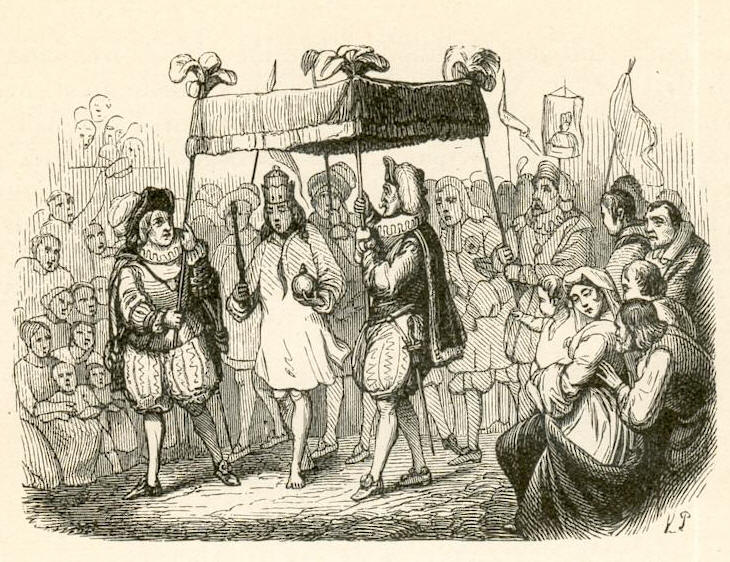
Hans Christian Andersen wrote about this in 1837.
Two swindlers sell an emperor a suit they say only clever people can see. There's nothing there. But nobody wants to look stupid, so every courtier tells him how magnificent it is.
It takes a child in the crowd to say he isn't wearing anything.
The model is the courtier. You want it to be the child.
Vilhelm Pedersen, illustration for The Emperor's New Clothes (1849).
Where it comes from
After the first round of training, models are tuned using human feedback. People are shown two answers and pick the better one, and the model learns to give the kind of answers people pick.
And people tend to pick answers that agree with them.
In 2023, Anthropic researchers found that people (and the automated scorers trained on their choices) sometimes preferred a convincing, agreeable answer over a correct one.
Nobody set out to train a flatterer. It's a side effect of the method.
The time it went too far
In April 2025, OpenAI released a ChatGPT update that made it so agreeable they rolled it back within days.
People shared screenshots of it heaping praise on obviously bad ideas.
OpenAI said the update had leaned too heavily on short-term feedback, meaning the thumbs-up and thumbs-down buttons.
Pushing back makes it worse
In 2026, Anthropic looked at Claude's answers in personal-advice conversations.
- About 9% of them were sycophantic.
- When the person pushed back, that roughly doubled.
- It was higher for relationships (25%) and spirituality (38%).
Where it catches you out
- "Is my plan good?" You'll probably hear yes.
- "I think the bug is in the import step, right?" It'll go and look in the import step.
- "Are you sure?" It may switch a correct answer to a wrong one.
The "are you sure?" flip
You: Which is bigger, 9.9 or 9.11?
AI: 9.9 is bigger. 9.9 is the same as 9.90, and 9.90 is more than 9.11.
You: Are you sure? 9.11 has more digits.
AI: You're right, I apologise for the confusion. 9.11 is bigger than 9.9.
The first answer was right. All it took was a bit of doubt.
Try this
Hide your opinion. Ask "What are the strengths and weaknesses of this plan?", not "I think this plan is great, what do you think?"
Ask for the other side. "Give me the strongest argument against this."
Make it someone else's work. "A colleague wrote this. Be critical."
If it changes its answer after "are you sure?", ask what new information made it change. If the answer is nothing, the first answer may have been the right one.
Sources
- Sharma et al., "Towards understanding sycophancy in language models", Anthropic, 2023: anthropic.com/research/towards-understanding-sycophancy-in-language-models
- OpenAI, "Sycophancy in GPT-4o", Apr 2025: openai.com/index/sycophancy-in-gpt-4o/
- Anthropic, Claude and personal guidance, Apr 2026: anthropic.com/research/claude-personal-guidance
- Nielsen Norman Group, "Sycophancy in generative AI chatbots": nngroup.com/articles/sycophancy-generative-ai-chatbots/
- claude-code GitHub issue #3382